
India’s Building Material Industry Faces Cost Surge as Iran War, Triggers Price Rise and Factory Shutdowns
- April 1, 2026
- By: Syed Md. Ehteshamul Hasan
- NEWS
Energy-driven cost escalation, shutdowns in Morbi, and ripple effects across cement, steel, and allied sectors
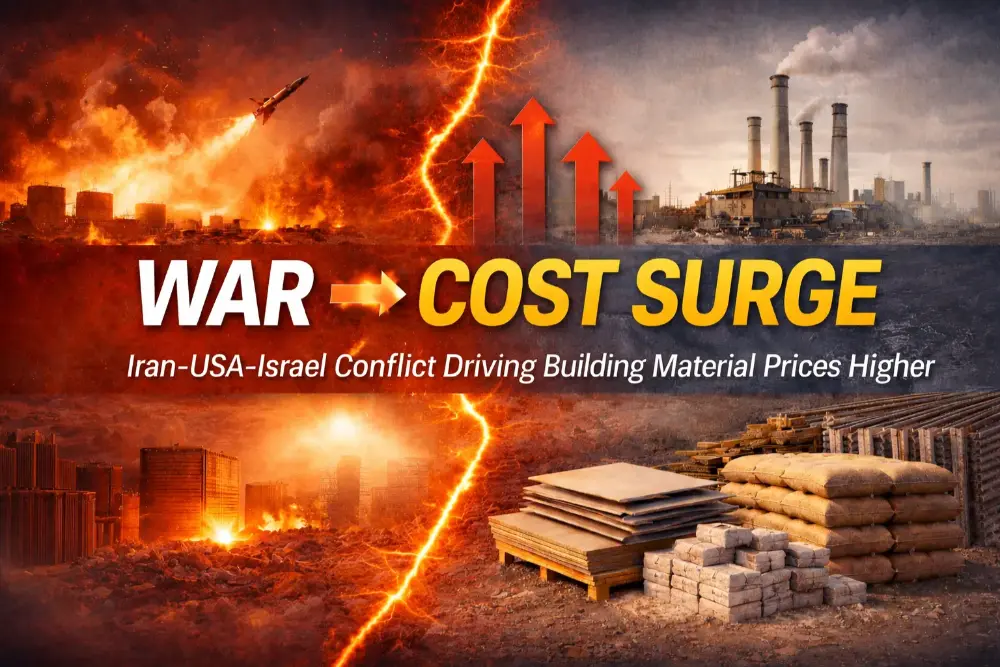
India’s building material industry is beginning to experience the Iran war impact on India building materials, as rising fuel prices and supply disruptions ripple across key sectors. The ongoing Iran-US-Israel war has triggered volatility in global energy markets, affecting LNG supplies, petroleum derivatives, and logistics costs. As a result, India’s construction ecosystem is witnessing escalating manufacturing expenses, production slowdowns, and growing uncertainty across supply chains. From Morbi’s ceramic clusters to cement plants and steel mills, the Iran war is translating into tangible cost pressures, marking the beginning of an India building material price hike 2026 scenario that could affect projects nationwide.
Energy Shock and Strait of Hormuz Disruption
The Iran-US-Israel war has significantly disrupted global energy supply chains, particularly impacting shipments through the Strait of Hormuz disruption route. A large portion of LNG and crude oil supplies move through this corridor, making India vulnerable to price fluctuations and supply delays. The LNG shortage India 2026 situation is already beginning to affect industrial consumers that rely heavily on imported gas.
With shipping risks increasing and freight premiums rising, fuel prices have moved upward, affecting ceramics, cement, steel, glass, and chemical manufacturing. The Strait of Hormuz disruption has therefore created a cascading effect on production costs, logistics, and inventory planning across India’s building material ecosystem.
Morbi Ceramic Factory Shutdown 2026: India’s Tile Hub Slows Down
The most visible outcome of the Iran war has been the Morbi ceramic factory shutdown 2026, impacting India’s largest ceramic manufacturing cluster. The Morbi ceramic factory shutdown 2026 began as propane and LNG supplies tightened, forcing several units to reduce production or halt operations.
Morbi, which accounts for nearly 70% of India’s tile production, is heavily dependent on gas-fired kilns. As fuel availability declined, manufacturers struggled to maintain continuous firing cycles. The shutdowns affected production volumes, labour availability, and export commitments, amplifying the Iran war impact on India building materials supply chain.
Industry stakeholders warn that prolonged disruption could further shrink output, creating supply shortages and accelerating price escalation across tiles and sanitaryware.
Price Rise in Tiles & Ceramic Bathware
One of the most immediate consequences of the Iran war has been a sharp price rise in tiles and ceramic bathware across India. The tile price increase India 2026 is being driven primarily by rising LNG and propane costs, along with production disruptions linked to the Iran-US-Israel war. Ceramic manufacturing is highly energy-intensive, with gas accounting for nearly 30–40% of production costs, making the sector extremely sensitive to fuel price fluctuations.
With several Morbi units operating at reduced capacity following the Morbi ceramic factory shutdown 2026, supply in the domestic market has tightened. Manufacturers have begun revising pricing across vitrified tiles, large-format slabs, sanitaryware, wash basins, and ceramic fittings. Industry sources indicate that the tile price increase India 2026 ranges between 8–12% in certain categories, with premium segments witnessing even steeper hikes.
Sanitaryware and ceramic bathware products are also experiencing cost escalation due to higher kiln firing expenses, packaging costs, and transportation charges. Dealers report frequent rate revisions and cautious inventory stocking, signalling the broader India building material price hike 2026 trend. If the Iran war continues to disrupt fuel supplies, stakeholders expect further price increases, which could significantly impact residential and commercial construction budgets.
LNG & LPG Shortage Ripple Across Manufacturing
The LNG shortage India 2026 is not limited to ceramics alone. The Iran-US-Israel war has reduced fuel availability across multiple industrial segments, creating a broader India LPG propane shortage affecting manufacturing clusters.
Steel re-rolling mills, glass units, and chemical manufacturers that rely on gas and propane are witnessing rising operational costs. The India LPG propane shortage has also increased cylinder prices, impacting MSME units that depend on spot purchases rather than long-term supply contracts.
This fuel shortage is pushing companies to either reduce output or pass costs to buyers, further intensifying the Iran war impact on India building materials.
Cement Price Hike Iran War Begins to Reflect
The cement price hike Iran war is gradually emerging as energy costs rise. Cement manufacturing is highly fuel-intensive, relying on petroleum coke, coal, and diesel for clinker production and logistics.
The cement price hike Iran war is being driven by increased petroleum coke costs, higher freight expenses, and rising electricity tariffs. Producers are evaluating price revisions as operating margins shrink, which could significantly contribute to India construction cost rise in infrastructure and housing projects.
Steel Sector Under Pressure
Steel producers are also affected by rising fuel costs and logistics disruptions linked to the Iran war. Secondary steel manufacturers that depend on LPG and gas are witnessing cost escalation in melting and rolling processes. Higher freight charges and raw material transportation costs are further pushing steel prices upward, adding to the India construction cost rise scenario across the sector.
MSME Building Materials Iran War Impact
The MSME building materials Iran war impact is particularly severe, as small units lack financial buffers. Brick kilns, sanitaryware units, paint manufacturers, and glass producers rely on LPG and diesel, making them vulnerable to fuel price spikes. Many MSMEs are reducing production hours or temporarily suspending operations, further tightening supply in the market.
Supply Chain Disruptions and India Construction Cost Rise
The cumulative impact of fuel price escalation and production slowdown is visible across the construction sector:
- Rising tile and sanitaryware costs
- Increasing cement and steel prices
- Higher transportation expenses
- Delays in project execution
- Shrinking contractor margins
These factors are collectively driving India construction cost rise across residential, commercial, and infrastructure projects.
About Building Material Reporter
Building Material Reporter (BMR) is India's leading media platform covering the building materials, construction, and architecture industry. From product launches and industry news to expert interviews and market trends, BMR keeps professionals, developers, and designers informed and ahead of the curve.
Visit: www.buildingmaterialreporter.com
Conclusion
The Iran war impact on India building materials is becoming increasingly visible across the sector. From Morbi ceramic factory shutdown 2026 to tile price increase India 2026 and cement price hike Iran war, the ripple effects are spreading rapidly. The Iran war is not only disrupting energy supply but also accelerating India construction cost rise, affecting developers, contractors, and end-users alike.
If the Iran-US-Israel war continues, India’s building material industry may witness sustained price escalation, production rationalisation, and long-term supply chain restructuring.
FAQs
1. How does the Iran war affect India's construction sector?
The Iran war has increased fuel prices, causing LNG shortage and transportation costs to rise. This has directly led to India construction cost rise as materials like tiles, cement, and steel become more expensive.
2. Why did Morbi ceramic factories shut down in 2026?
The Morbi ceramic factory shutdown 2026 occurred due to propane gas shortage triggered by the Iran war. Limited fuel supply disrupted kiln operations, forcing manufacturers to halt production.
3. How much have tile prices increased in India due to the Iran war?
The tile price increase India 2026 is estimated at around 8–12% across categories. The Iran-US-Israel war has raised fuel and logistics costs, leading to price revisions.
4. Which industries in India are most affected by the Iran war?
The Iran war impact on India building materials is most visible in ceramics, cement, and steel sectors. These industries rely heavily on imported fuel and energy-intensive manufacturing.
5. Will cement prices continue to rise due to the West Asia conflict?
The cement price hike Iran war is linked to petroleum coke and fuel costs. Continued energy volatility may further increase India construction cost.
6. How is the Strait of Hormuz disruption impacting India's energy supply?
The Strait of Hormuz disruption is affecting LNG shortage India 2026 and contributing to India LPG propane shortage. This is increasing fuel prices for industrial users