
Iran War Disrupts India’s Building Material Trade: Tile Dealers Report Price Hike and Supply Shortage 2026
- April 6, 2026
- By: Syed Md. Ehteshamul Hasan
- NEWS

Tile price hike in India 2026, building material supply shortage, and freight disruption — dealers from Kolkata to Kannur share ground-level impact
India’s building material trade is experiencing significant turbulence as dealers across the country report rising prices, inconsistent supply, and growing uncertainty following the Iran war building material trade India scenario. In an exclusive interaction with Building Material Reporter, traders from eastern, southern, northern, and north-eastern markets highlighted that the Iran-US-Israel war has triggered an energy-led disruption affecting tiles, sanitaryware, and other energy-intensive construction materials.
The Iran war impact India tiles dealers is particularly visible in the ceramic segment, where rising gas prices, temporary manufacturing shutdowns, and logistics bottlenecks are constraining availability. From Kolkata to Kannur, Bengaluru to Guwahati, Jalandhar to Gorakhpur, and Manali to Farrukhabad, traders emphasised that while demand remains stable, supply uncertainties and fluctuating pricing are complicating planning and execution. The emerging building material price hike India 2026 trend is already affecting project budgets, procurement cycles, and dealer margins nationwide.
Many traders also noted that the current disruption differs from previous supply shocks, as it combines energy volatility, logistics challenges, labour shortages, and export constraints. The cumulative effect is reshaping the building material trade ecosystem, with dealers adopting cautious inventory strategies and customers delaying purchase decisions amid uncertain pricing.
Tile Price Hike In India 2026 and Rising Material Costs
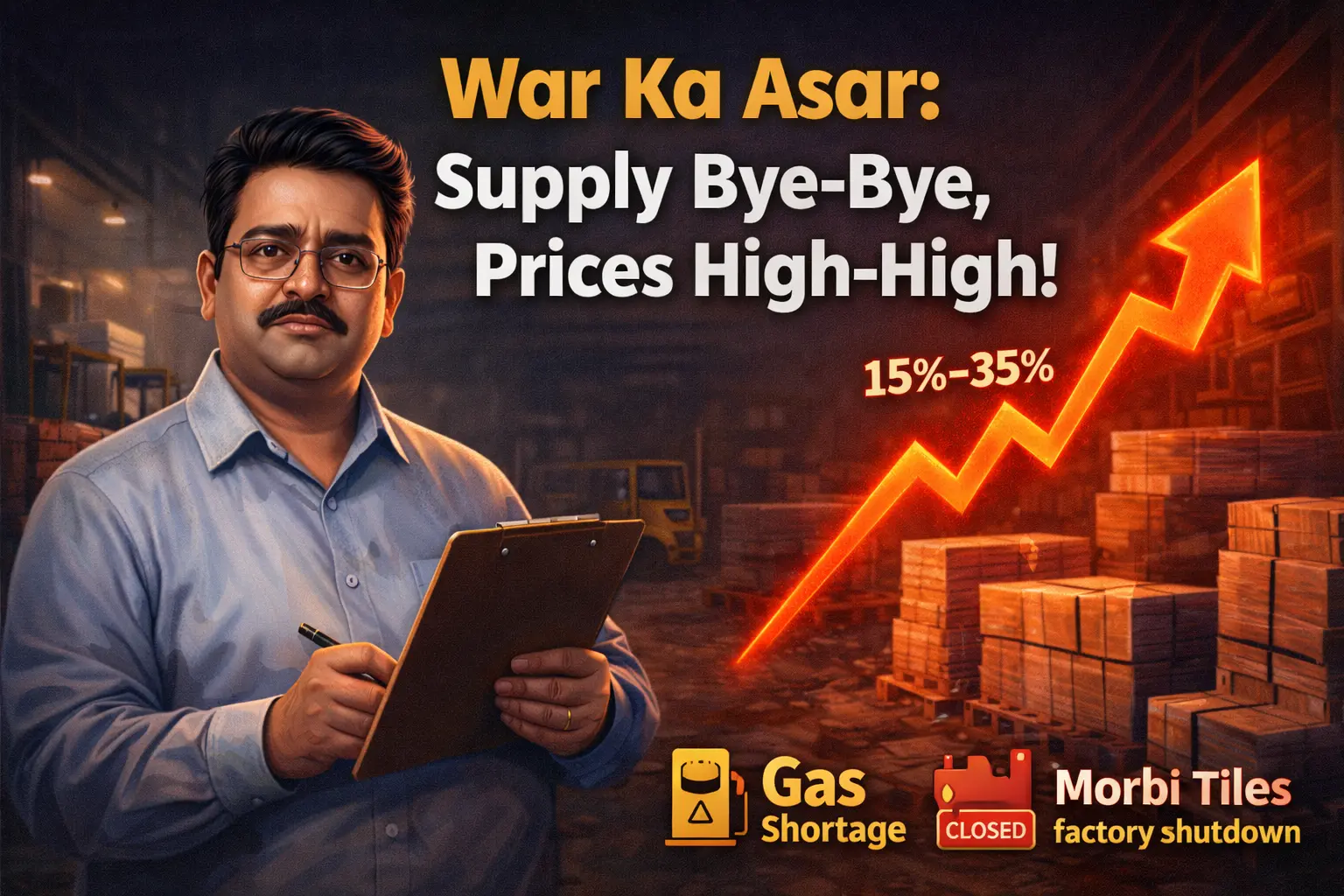
The tile price hike in India 2026 has emerged as one of the earliest and most visible outcomes of the Iran war building material trade India disruption. Aman Chhawchharia of Neolithic Ceramica, Kolkata, highlighted that brands such as Simpolo, Nitco, Somany, Kajaria, and Qutone have already implemented price increases ranging between 15–35%, including surcharges. He noted that while some surcharges may be temporary, the base price increase is expected to remain due to rising production costs.
Chhawchharia further explained that demand remains intact, particularly in residential and commercial projects, but supply disruptions have created uncertainty. Several large projects that began months earlier are now facing challenges in maintaining consistent supply. Dealers are also cautious about confirming rates for future deliveries, as manufacturers are revising pricing frequently. This uncertainty is forcing developers and contractors to reassess budgets and timelines.
Similar trends are being reported in southern markets. Silvan Musthafa, Founder & CEO of Silvan Business Group, Calicut, observed that tile prices have risen noticeably in recent weeks due to manufacturing disruptions and gas shortages. He pointed out that Kerala’s strong economic linkage with Gulf countries has amplified the impact, with uncertainty in Middle East markets slowing construction activity. Residential and resort projects are being paused or delayed, and customers are adopting a cautious approach to procurement.
Musthafa further noted that disruptions in gas supply have severely impacted tile manufacturing hubs such as Morbi, where a significant portion of India’s production is concentrated. Several units have reduced output or temporarily halted operations due to limited gas availability and rising energy costs. While large dealers currently hold inventory sufficient for one to two months, smaller dealers are already facing shortages. Manufacturers have begun implementing price increases, and further hikes are anticipated due to rising transportation costs and constrained production.
The situation is particularly critical in Kerala, where construction activity is closely linked to Gulf remittances. With uncertainty in Middle East markets, investment decisions are being postponed. Dealers are therefore managing short-term commitments cautiously while informing customers about potential price revisions and delivery delays. If disruptions continue, the tile price hike India 2026 trend is expected to intensify further.
Alpesh Gajera from Simpolo Sanitation Pvt. Ltd., Bengaluru, also reported price increases of nearly 20–35% across several building products. He attributed the rise to limited gas availability, labour shortages of nearly 30–40%, and rising logistics costs. According to him, production constraints are making it difficult to honour delivery commitments, thereby pushing prices upward.
Building Material Supply Shortage In India 2026 Intensifies
The building material supply shortage India 2026 is becoming increasingly evident as manufacturing hubs operate below capacity. Avinash Sarawgi, Proprietor of Shri Mahavir Marbles & Granite, Guwahati, explained that halted production at manufacturing units—particularly in Morbi—has significantly reduced availability. He noted that prices have increased by nearly 20–30%, while demand has weakened as projects face delays. Payment cycles have slowed, previous dues remain outstanding, and liquidity pressure is building for dealers.
Sarawgi added that newly established showrooms are particularly vulnerable, as high operational costs and limited stock make it difficult to sustain business. With tile supply shortage India 2026 conditions emerging, dealers are struggling to maintain inventory and meet project requirements.
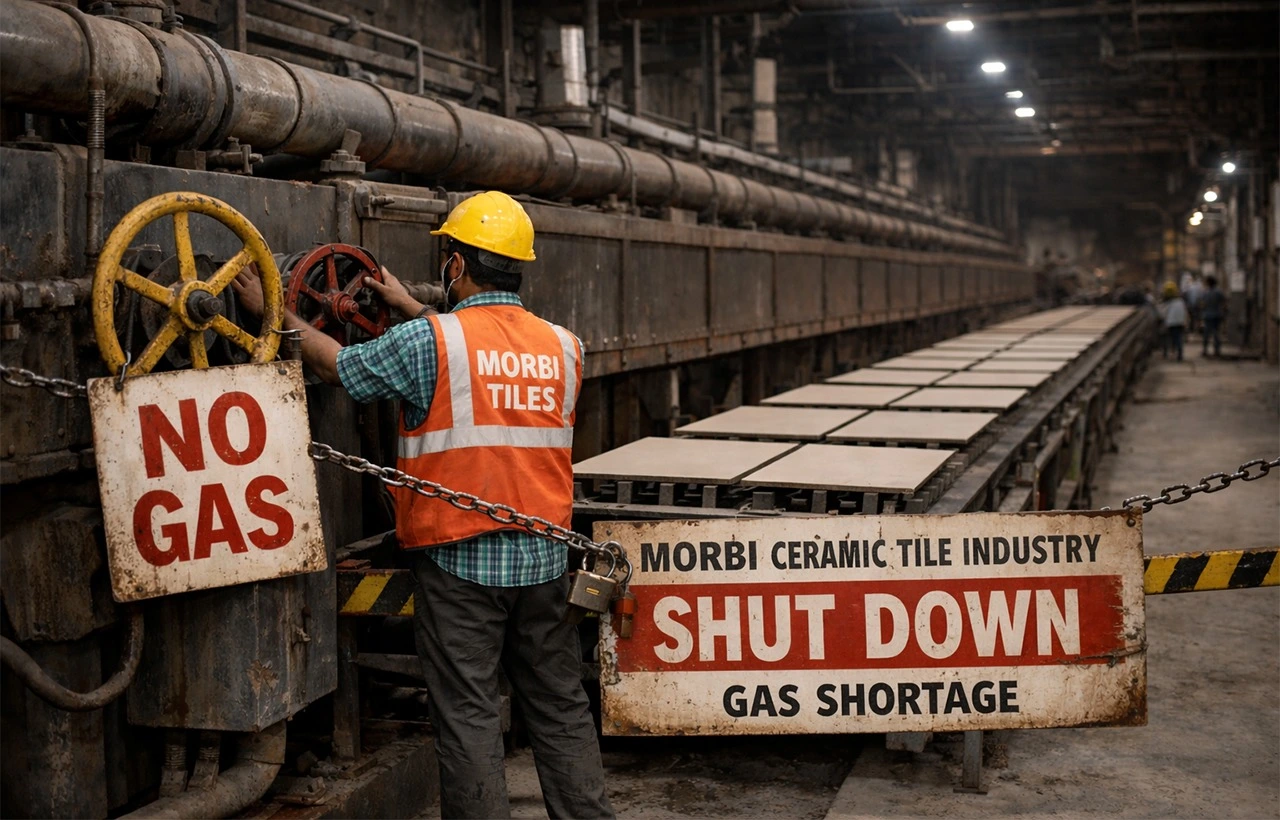
Rajiv Jaiswal of Vasundhra Hardware, Hata in Kushinagar, highlighted that abrupt suspension of gas supply forced tile plants to halt operations. The Morbi shutdown tile supply India disruption has left dealers with minimal inventory and limited sourcing alternatives. Transportation of raw materials such as clay has also been affected, further delaying production resumption.
He further noted that restarting tile plants requires uninterrupted gas supply, making intermittent operations difficult. Freight costs have increased by nearly 30–40%, adding to procurement expenses. As a result, tile supply shortage India 2026 is becoming more pronounced across regions.
Freight Cost Increase Adds Pressure
The freight cost increase building materials India scenario is compounding supply challenges. Lal Chand of Salasar Tiles & Granite, Manali, observed that limited vehicle availability and higher dispatch costs are affecting material movement. Some manufacturers are continuing limited production using restricted gas supply, but at higher costs, resulting in price increases of ₹5–7 per sq. ft. Dealers are therefore cautious about committing rates for large projects, as replenishing stock at revised prices remains uncertain. Passing on sudden cost increases to customers is also difficult, particularly for projects finalised at earlier rates.
Rajat Agarwal of Rajat Enterprises, Farrukhabad, echoed similar concerns, noting that dispatch schedules have become inconsistent and vehicle availability limited. Dealers are now placing orders only after confirming stock availability, unlike earlier when supplies were predictable. This change in procurement patterns is slowing routine business operations and affecting project timelines. The uncertainty surrounding supply and transportation is forcing traders to maintain conservative inventory strategies.
No wonder, traders strongly feel that with limited factory output and growing logistical challenges, fulfilling previously committed project requirements is becoming difficult, compelling dealers to inform customers about possible delays. The situation is particularly critical in regions heavily dependent on overseas economic activity, as slowdown in Gulf markets is directly impacting construction investment and making the near-term outlook highly uncertain.
Energy-Led Disruption Impacting Global Trade
Mohammed Madani, Founder & Managing Director of ABC Group, having presence across South India, Middle East and Africa, emphasised that the building material traders Iran war impact extends beyond India. With operations across multiple international markets, he highlighted rising fuel costs, logistics challenges, and factory shutdowns affecting trade globally. Shipping costs have increased, availability has reduced, and production constraints due to energy shortages are affecting export commitments. He also observed that labour availability has been impacted in certain regions due to rising living costs.
Madani further explained that rising energy costs are reducing manufacturing capacity, particularly in energy-intensive segments such as tile production. Limited operational factories and increasing fuel prices are constraining output, leading to supply shortages. Logistics disruptions and shipping delays are affecting both domestic distribution and exports, making procurement planning difficult for dealers and distributors.
The situation is further aggravated by labour shortages, as workers face rising living costs and limited access to essential resources such as cooking gas. Many workers are returning to their hometowns, creating manpower gaps in factories and construction sites. This has resulted in production delays and slower project execution across markets.
Madani also pointed out that India’s dependence on imported crude oil and gas has made the domestic market vulnerable to global price fluctuations. As energy costs surge, manufacturing and transportation expenses increase, leading to price escalation across building materials. Supply chain disruptions and high shipping costs are also affecting exports to markets such as the Middle East and Africa, reducing business volumes significantly.
Overall, he observed that the industry is witnessing reduced availability, rising costs, halted production in certain factories, and declining trade volumes. While stronger and well-established companies may benefit from consolidation, the short-term outlook remains challenging.
Iran War Intensifies Dealer Margin Pressure
Dealer margin pressure Iran war is becoming a key concern for traders. Gagan Arora of Sri Om Trading Company, Jalandhar, described the impact as moderate but increasingly noticeable. He explained that rising gas prices have increased production costs, which are being passed on to the market. While some dealers had stocked material earlier, existing inventories are gradually depleting and fresh supplies remain uncertain. This situation is forcing dealers to revise pricing frequently, while also facing resistance from customers who had planned budgets based on earlier rates.
The Iran war impact India tiles dealers is also visible in margin compression. Dealers are under pressure to honour commitments made at earlier rates, even as procurement costs rise. Fluctuating rates and limited supply are making it difficult to quote for new projects, leading to cautious business decisions.
Building Material Project Delays In India 2026 Emerging
The building material project delays in India 2026 trend is becoming increasingly visible. Supply shortages and price volatility are prompting developers to delay procurement decisions. Some projects are being executed in phases, while others are temporarily paused.
The Gulf remittance India construction slowdown is particularly affecting regions such as Kerala, where investment is linked to overseas earnings. Traders noted that uncertainty in Middle East markets is reducing construction activity and affecting demand.
About Building Material Reporter
Building Material Reporter (BMR) is India's leading media platform covering the building materials, construction, and architecture industry. From product launches and industry news to expert interviews and market trends, BMR keeps professionals, developers, and designers informed and ahead of the curve.
Visit: www.buildingmaterialreporter.com
Conclusion
The Iran war building material trade India disruption is reshaping market dynamics, with tile price hike India 2026 and building material price hike India 2026 trends gaining momentum. Supply shortages, freight cost increases, and production constraints are affecting dealers nationwide.
Unless energy supplies stabilise and manufacturing resumes at full capacity, building material supply shortage India 2026 conditions may continue, impacting project timelines and dealer margins across the country.
FAQ
1. How is the Iran war affecting building material dealers in India?
The Iran war building material trade India disruption is causing supply shortages and building material price hike India 2026 trends. Dealers are facing tile price hike India 2026 and rising logistics costs.
2. How much have tile prices increased for dealers in India due to the Iran war?
The tile price hike India 2026 ranges between 15–35%, particularly for brands such as Simpolo, Kajaria, and Nitco.
3. Why is building material supply disrupted across India in 2026?
The building material supply shortage India 2026 is driven by Morbi shutdown tile supply India and gas shortages affecting production.
4. How are rising freight costs affecting building material prices in India?
The freight cost increase building materials India — nearly 30–40% — is increasing procurement costs.
5. Which regions in India are most affected by the building material trade disruption?
The Iran war building material trade India impact is visible in Kolkata, Kerala, Bengaluru, Guwahati, and Jalandhar.
6. How are dealers managing margin pressure due to the Iran war?
Dealer margin pressure Iran war is forcing traders to revise pricing, manage inventory carefully, and delay commitments.
Related News: India’s Building Material Industry Faces Cost Surge as Iran War, Triggers Price Rise and Factory Shutdowns